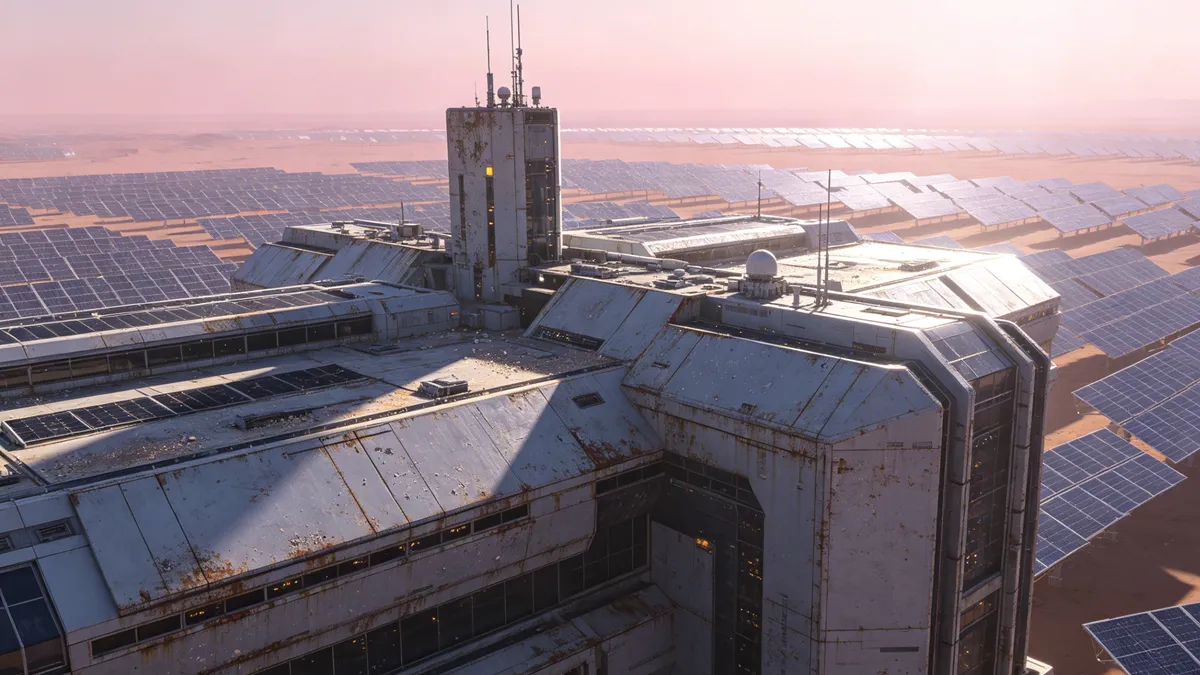
In a move that has sent shockwaves through the corridors of power on Earth and sparked jubilant celebrations across the Martian colonies, the Martian Parliament today voted unanimously to sever all ties with the Earth-based Carbon Credit Exchange, effectively declaring economic independence from the planet's crumbling regulatory regime. The decision, passed under the Emergency Sovereignty Act of 2126, marks the first major political rupture between Mars and its home planet since the first colonists landed a century ago.
At the heart of the dispute is the 'Legacy Carbon Credit' system, a vestige of 21st-century Earth policy that Mars has been forced to participate in for decades. Under the system, Martian industries are required to purchase credits from Earth's carbon markets for every ton of CO2 emitted during production—even though Mars' atmosphere is 95% carbon dioxide. 'It's like charging fish for water,' said Martian Chancellor Isa Martinez in a fiery speech before the vote. 'Earth's bureaucrats have been taxing our very air, while their own industries pump out real pollution with impunity. No more.'
The decision has immediate and far-reaching implications. Martian corporations, from the vast agro-domes of the Tharsis region to the orbital manufacturing hubs of Phobos, will no longer need to comply with Earth's carbon accounting. Instead, they will operate under a new 'Mars Green Standard,' which calculates emissions based on the planet's unique environment and prioritizes local sustainability metrics. The move is expected to slash operational costs by an estimated 40% and accelerate Mars' transition to a fully self-sufficient economy.
Earth's reaction has been predictably hostile. The United Nations Economic Council, headquartered in Geneva, issued a statement condemning the decision as 'a reckless act of environmental sabotage' and threatening sanctions on Martian imports. But the threats ring hollow: Mars now produces 70% of its own food, 90% of its manufactured goods, and is the sole supplier of aneutronic fusion fuel—a critical resource for Earth's struggling energy grids. 'Let them sanction us,' laughed Helium-3 magnate Jaxon Reed. 'They'll be freezing in the dark within a month.'
Wall Street, however, is panicking. The Carbon Credit Exchange, once a trillion-dollar market, is now facing collapse as its largest buyer walks away. 'This is a systemic shock,' admitted analyst Lena Petrova of Goldman Sachs Quantum. 'We're seeing a massive sell-off in carbon futures and a flight to what? Martian credits? It's absurd.' Indeed, the Martian Parliament has cheekily announced its own 'Freedom Carbon Credits,' trading on the newly formed Olympus Mons Exchange, which are already outselling Earth's legacy credits by a factor of ten.
[SPONSORED]
DON'T PANIC.
Buy a towel. Standard galactic survival gear. Aisle 42 at the Space-Mart.
The timing of the break is no accident. It comes just weeks after Earth's failure to enforce the New Delhi Accords, which were supposed to cap industrial emissions globally. Mars has long argued that Earth's climate policies are a farce, with the old powers continuing to burn fossil fuels while exporting the cost of mitigation to the colonies. 'They talk about net-zero but they mean net-zero for us,' said Martinez. 'We are building a civilization on a barren rock with less than 1% of Earth's atmosphere. We don't need their permission to survive.'
The independence movement on Mars has been brewing for years, fueled by a growing sense of identity and frustration with Earth's 'bureaucratic colonialism.' The issue of carbon credits became a rallying cry, symbolizing the unequal relationship between the old world and the new. Social media on Mars exploded with memes mocking Earth's 'Carbon Kings,' and a viral hashtag #MarsNotForSale trended for weeks. The vote today was the culmination of a grassroots campaign that united colonists across the political spectrum.
Critics on Earth warn that the move could trigger a cascade of similar declarations from other off-world colonies, such as the Lunar Free State and the Ceres Mining Cooperative. 'It's the beginning of the end for centralized Earth governance,' warned political scientist Dr. Evelyn Hart. 'Mars has shown that you can just walk away from the old system. What's to stop the others?' For now, Mars is basking in its newfound autonomy. The streets of Argyre City and New Houston are filled with impromptu celebrations, and the official Mars News Network has declared a 'Day of Liberation.'
But the real test will come in the months ahead. Earth is unlikely to roll over quietly; there are rumors of a trade embargo and a freeze on technology transfers. Yet Mars has prepared for this. Its decentralized economy, based on 3D-printing and local resource extraction, is designed to withstand blockades. And with the first generation of 'Born-on-Mars' children now adults, the colony has a fierce pride that no Earth policy can crush. As Chancellor Martinez concluded her speech: 'We didn't travel 140 million kilometers to be told how to breathe. Welcome to Mars, where the air is free—literally.'